
A prodigious failure
The Life and Zen Haiku Poetry of Santoka Taneda

I’m fascinated by over-achievers whose lives dangle from their remarkable work like pendulous atrophied bodies dangling from enormous heads.
There’s Paul Erdős, the Hungarian mathematician who wandered for decades, descending upon successive colleagues for amphetamine-fueled marathons of proof-making, a man whose life was nothing but math. There’s Georges Simenon, the Belgian crime novelist whose obscene productivity coincided with a bottomless sex addiction. There’s Henry Darger, an American janitor who labored in poverty and isolation on a 15,000-page illustrated novel that was only discovered by his landlord when he died. My list is long, and it embraces every kind of art and craft and science. The most recent addition is the Japanese poet Santoka Taneda.
He was brought to my attention this month by Victoria Stoilova, Substack’s own flaneuse-translator-sage, who suggested I read about him. At my library I found Sumita Oyama’s The Life and Zen Haiku Poetry of Santoka Taneda, translated by William Scott Wilson. I read it, and I’m glad I did. Like the others in my abject pantheon, Santoka produced a remarkable body of work in wretched circumstances of his own making. Contemplating his case feels like studying an inscrutable parable more than simply rubbernecking at a catastrophe.
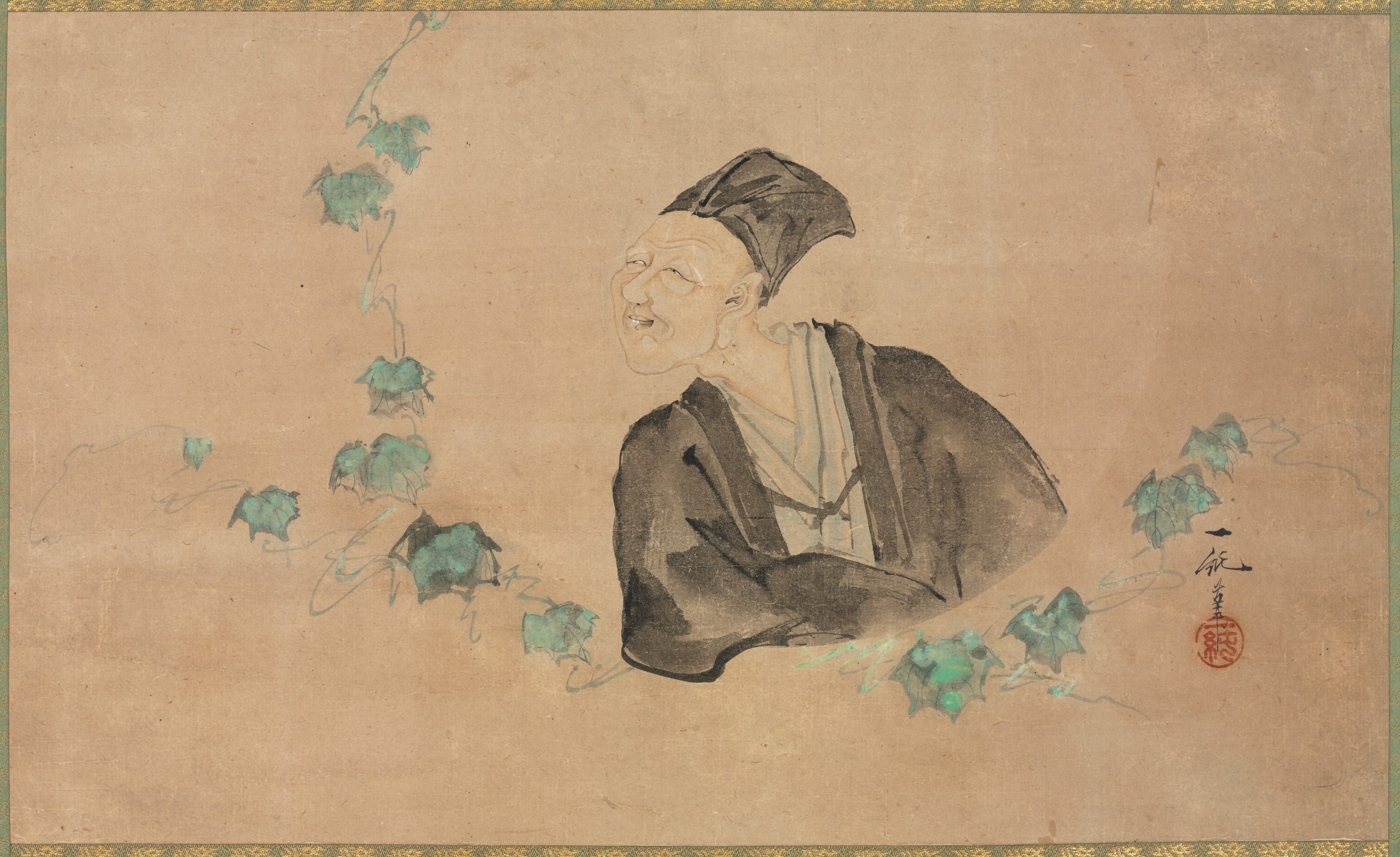
Santoka was born in Japan to a wealthy landowner in 1882. His name was originally Shoichi Taneda. Santoka is a pen name. His father was a womanizer, and for this reason, according to Santoka’s diaries, his mother committed suicide when he was eleven. Santoka watched as her body was pulled from the well where she’d thrown herself.
He went to Tokyo to study literature, but he had to drop out for obscure reasons. Some say it was too much drunkenness. Others suggest it was because his father couldn’t afford his tuition anymore. Certainly the father was in financial straits. He sold off family land and went into business with his dropout son as a sake brewer. This was a terrible environment for Santoka. His college drunkenness was ballooning into full-blown alcoholism.
Santoka’s father also coerced him to marry, setting him up with a local girl, with whom Santoka eventually had a son. This poor woman and her son would suffer from Santoka’s spectacular collapse, but first the family had a bit more sinking to do.
The sake brewery went bankrupt. Somehow they had managed to spoil two entire years’ worth of stock. Santoka moved his family to Kumamoto City, where they opened a small shop. It did not prosper. So at thirty seven years old he went alone to Tokyo looking for a job. His wife’s parents insisted he divorce her. (Remarkably, Santoka’s ex-wife continued to think and care about him for the rest of his life, sometimes sending him clothes or money, even though he’d more or less abandoned her to run a store by herself and raise their boy alone. His diaries record the wonderment and remorse her gifts caused him.) But he couldn’t cut it as a wage laborer any more than he had as a student, a brewer, or a shop owner. Too much drinking. As if to spit on him while he was down, the universe also arranged for a megathrust earthquake to hit Tokyo while he was there. Over 100,000 people died, and 2 million became homeless. Santoka survived and returned to Kumamoto City.
In 1924, in his early forties, while very drunk, he stepped in front of a tram.
Was it a suicide attempt? It ran in the family. His brother had followed their mother in suicide, to escape debts. At any rate, this event marked the turning point of Santoka’s life. The tram conductor managed to brake in time, and a kindly onlooker led the drunk man away and deposited him at a local Zen Buddhist temple.
Santoka converted. In fact, he decided to become a priest. He shaved his head, memorized sutras, and took up residence as the caretaker for a small, isolated shrine. But this didn’t work out either. He missed sake too much, and he possessed a kind of incurable wanderlust (though, reading between the lines, this wanderlust may also have become a prudential necessity, since he tended to wear out his welcome). But unlike his other failures, he didn’t simply walk away from this one: he walked inside it. He became a wandering beggar priest.
Giving alms to a priest is institutionalized in many forms of Buddhism as a pious act. Santoka had finally discovered a career he would be good at. It’s how he spent the majority of the last fifteen years of his life. Except, even as a beggar priest, he was something of a screw up. The moment he got more than rice in his bowl, or more than enough alms to buy rice, he’d spend the extra on sake or sochu and get blackout drunk. Despite the familiar narrative contours of his religious conversion—the salvation from vice—he never overcame his alcoholism. For the years that remained, he lived a very simple life: he walked, he begged, he drank—and he wrote haiku.
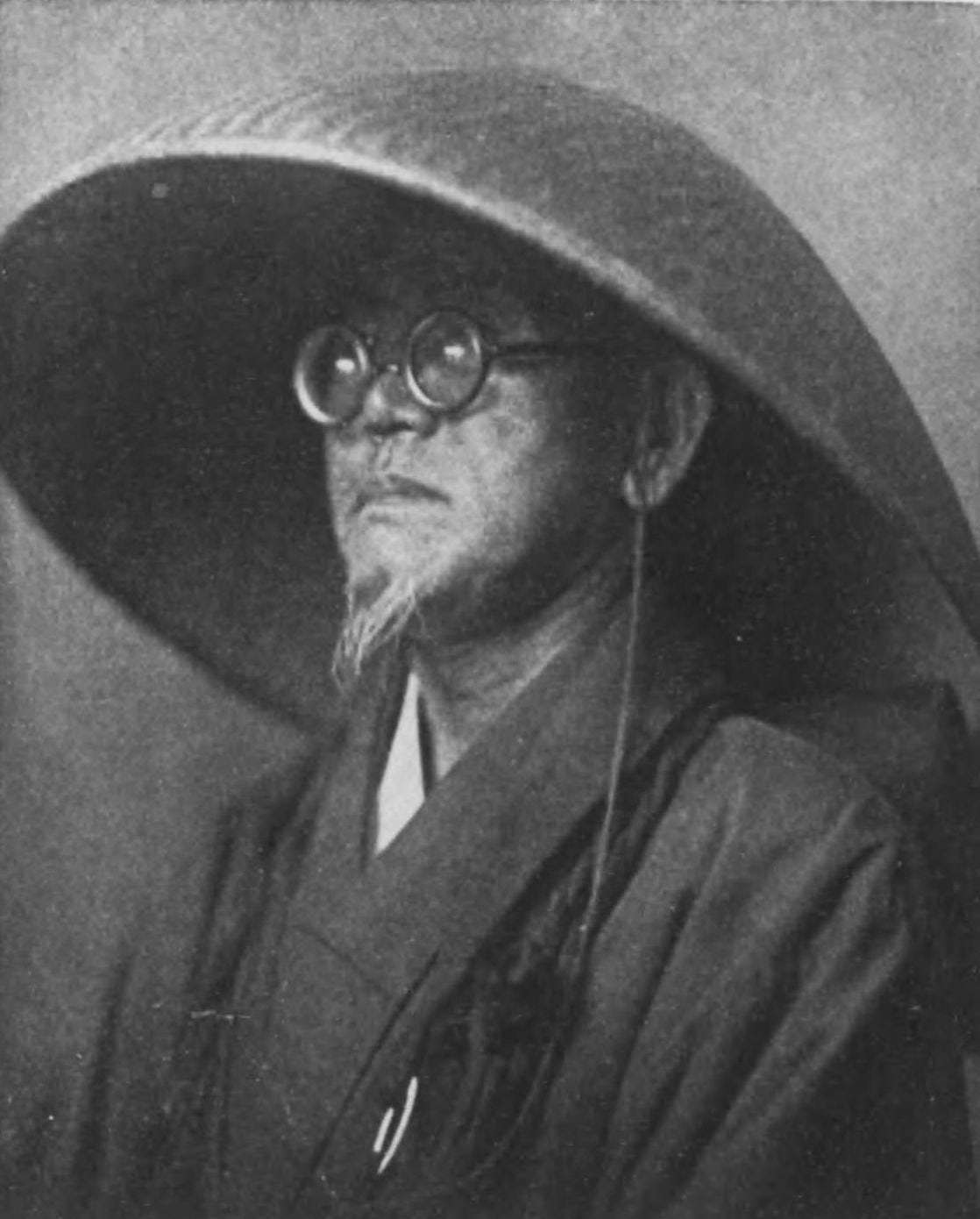
He wrote a lot of haiku. Sumita Oyama shares this report from the end of one manuscript he received of Santoka’s poems:
The number of poems I have belched forth between July of last year and October of this year is close to two thousand. From among those I have picked out three hundred. Then, making a final selection, I have put together the one hundred and forty-one verses.
Oyama was impressed. Though his friend seemed “a slovenly drunkard who had overstepped his bounds,” in one respect he was a man of discipline, ruthlessly adhering to “his own first principle of the Way of Haiku.” He destroyed more than 90% of his poems, writing them as easily as he breathed, saving and publishing only the very best.
The kind of poetry Santoka wrote is called free verse haiku. This means two rules of the older form have been dispensed with: the 5-7-5 rule and the requirement to include a word signifying the season. The results are unmeasured imagistic squirts of observation or feeling. You can read many of them online.
As with all translated haiku, I find myself sadly perplexed by what are considered great poems by those who truly understand them. There’s too much between the lines that I can’t see, and translators of Japanese poetry into English have a tendency to fall back on an ambiguous minimalism, which may capture the openness of these literary forms and their actual physical dimensions, but does not capture the abounding excess of meaning they (presumably) have in the original.
Take, for example, this famous haiku by Santoka, from R. H. Blyth’s History of Haiku:
My rainhat’s
leaking
too?
Burton Watson’s translation of the same poem:
Has my hat too
sprung a leak?
On Wikipedia, some well-meaning annotator (though it doesn’t cite a source) suggests we should interpret this poem to mean:
I’m traveling by myself wearing a straw hat.
It began to rain, and my face began to get wet.
There is no place to take shelter from the rain in an unpopular place.
But I keep walking.
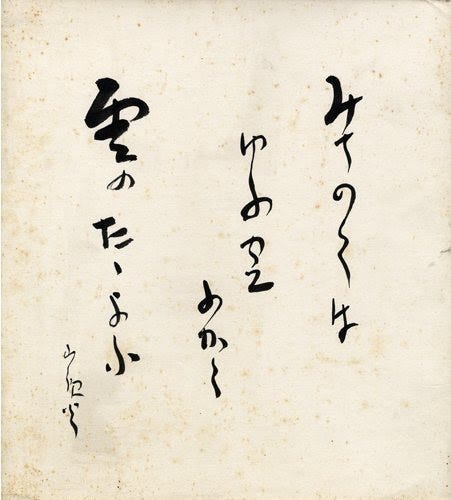
Well... If indeed that’s what’s supposed to go through my mind after reading the four to seven words offered by translators, I’m definitely missing a lot. My preference would be wordy over-interpreted translations that give some sense of what it’s actually like to appreciate these poems. At the same time, I recognize some of what’s to be appreciated is the visual beauty of the concise formulation. Pictures I’ve seen of Santoka’s own originals look like smoke captured in ink.
Despite my basic aesthetic inadequacies before a form like translated free-verse haiku, in aggregate Santoka’s poems give me a sense of what makes him so popular. They add up to a tremendously vivid patchwork evocation of his few possessions, simple lifestyle, and existential struggle: a tattered priest’s robe, bamboo hat, straw sandals, wooden bowl; begging, walking, enduring weather, eating plain rice, drinking sake; pursuing the meditative consciousness of a Buddhist and a poet, and simultaneously suffering an irresistible thirst for alcohol.
As is almost always the case with my pantheon of prodigious failures, Santoka was not just a hypertrophied artist whose non-creative life had atrophied. The connection between creative accomplishment and personal failure is deeper, stranger. Is Coleridge conceivable without the addictive personality that made him a slave to opium? Is Glenn Gould conceivable without the persnickety precision that led him to his isolated indoor life, a sort of vampire pianist? Is Vivian Maier conceivable without her nanny cover story, the quintessential urban photographer as deep cover spy?
I’m not making some tedious point about how great artists have to suffer or hide. I don’t believe that, and history doesn’t bear it out. Instead, I’m suggesting that for some people, the same configuration of personality that makes their lives so strange—and often so stunted and sad—is also the source of their exceptional work. The misery doesn’t cause the intensity; both flow from the same source.
In Santoka’s case—and granting that I just met him and am ill-equipped to fully appreciate his art—I feel as if I can just barely make out this inner source. There was some kind of battle in this man between a wish to be all present, exposed to the world as a raw tingling nerve, and a desire to vanish: presence vs. oblivion. These desires sometimes opposed and sometimes flowed into each other. He called the category of person he belonged to—transient, indigent—the Kings of the World, because they lived fully in the present, accepting what allowed them to survive from day to day and choosing to life wholly in the moment. And yet he confronted often and regretted deeply the way he had cornered himself in this life, betraying everyone who depended upon him, just because he loved sake. Satisfaction and regret, embrace and rejection of his lifestyle, pleasure in the moment and agony in the loss of a past or future: so many of Santoka’s thoughts and feelings revolved around the interplay of presence and oblivion.
Take his changing perspective on religion, for example. At first it is supposed to save him from sake: the presence of Zen Buddhism vs. the oblivion of drunkenness. But after he realizes he cannot banish his addiction merely through religious practice, he recruits what he knows of his religion to rationalize his drinking. It would be religiously inappropriate to abstain from sake, because the true ideal is moderation not abstention, so he must drink, he tells himself. Otherwise how will he achieve moderation? Religion has become an ally of oblivion. Toward the very end of his life, when he knew sake was killing him but had come to embrace it, approving the way it gave him peace and even improved his poems, he concluded it was foolish to pretend to aspire to moderation or pay lip service to the priestly ideal. It particularly troubled him to prey upon the pious generosity of alms-giving strangers in order to quench his thirst. Santoka can only be Santoka, he announced. The haiku pilgrims who visited him would bring gifts of alcohol. He set aside his sutras and proclaimed himself no begging priest, but simply a beggar. Here the polarities have shifted: now sake is on the side of presence and religion is on the side of oblivion, because religion prevents Santoka from being Santoka.
Yes, a lot of this sounds like the rationalizations of an addict, but it still matters what one chooses to produce rationalizations about. Squirming around to escape the constraints of an uncomfortable ideal is evidence that it has some purchase on your conscience. For Santoka this ideal was presence, opposed always by an instinct for oblivion.
In his art, he chose presence. The effort to do so, swimming against the undertow of oblivion, is the energy that drives his poetry. In his life, oblivion won. He died drunk in a room next door to a meeting of his haiku circle. They tip-toed out after their party, so as not to disturb his stupor. His body was found cold in the morning.
The Life and Zen Haiku Poetry of Santoka Taneda, by Sumita Oyama.
Translated by William Scott Wilson.
(Tuttle Publishing: 2021.)
This post provokes so much exciting recognition on my end — mostly our overlap in interest in these sorts of creative figures, and also the insight you’re drawing between their ways of being and specific creativities — that I can’t do the recognition justice in this moment so I won’t try. Instead I’m going to venture the way I interpret that haiku, which I actually find myself quite liking even though I don’t generally get poetry. Is it possible that the haiku, by mentioning the rain hat “too” or “also” leaking (I’m on my phone so can’t scroll back up to the actual translation), is simply an elegantly wry way to say: “It’s raining.”